Mother Up: A Washington, D.C. Research Pilot Project on Guaranteed Income
“Mothers and their children should not be separated because of poverty.”
Melody Webb, Executive Director and Founder
Mother’s Outreach Network
Mother Up Guaranteed Income Research Pilot Project is part of the broader mission of Mother’s Outreach Network (MON), a constituent-driven nonprofit advocacy organization that tackles the root causes of poverty by advancing the inclusion, rights, and empowerment of Black mothers impacted by the child welfare system because of economic instability and racial injustice. The three-phase Project, conducted with mothers living in Washington, D.C., is designed to further the national effort to address poverty as a root cause for many of the societal problems afflicting communities across the United States.
Note: Enrollment cycles for both Mother Up Phases I and II have concluded. Payment for Phase II cycle concluded in August 2025 and payment for Phase I cycle concluded in April 2026.
Click here for a report of Phase II of the Project
Following is a brief description of The Mother Up Research Pilot Project.G
Introduction
Poverty is not neglect. Poverty is not a failure of human behavior. Rather, poverty is the result of a combination of systemic failures violently impacting individuals’ circumstances.
Significantly, poverty has been identified as a risk factor for child neglect (Cai, 2021) , underscoring the importance for policymakers to prioritize poverty eradication as a strategy for decreasing instances of child neglect. Unfortunately, influenced by racialized tropes and entrenched hierarchical structures, policymakers often overlook poverty as the core reason that child protective services need to engage with families. This has resulted in a sorely misdirected system of family policing and family separation rather than a supportive system to help families address the conditions of their poverty.
Although the District of Columbia Code explicitly states that poverty alone should not be grounds for neglect or abuse findings, poverty remains a driving force behind the majority of child welfare cases. D.C. Code § 16-2301 (9)(A) ii.
Financial hardship, often compounded by systemic racism, continues to be a central mechanism through which families are surveilled, separated, and regulated.
Traditional supports like legal services and parenting groups offer valuable resources, but they do not address the root cause: economic insecurity. Programs such as Temporary Assistance for Needy Families (TANF) provide financial assistance, yet they are frequently tied to work requirements and substance use restrictions criteria that can exclude the very families most in need of support.
Black mothers living in Washington, D.C. face disproportionate surveillance and intervention at the intersection of racialized poverty and family regulation. Of the approximately 2,200 families involved in the D.C. foster care system, over 80% are Black and live in poverty. Among the many reasons that these Black families are in economic crisis is directly related to the fact that Black women in D.C. earn just 51 cents for every dollar earned by white men.
Mother Up Research Pilot Project Overview
MON is a leader in the national guaranteed income movement to provide regular, unconditional cash payments to individuals to create an income floor, reduce poverty, and address economic and racial inequality. Its Mother Up Research Pilot Project is a preliminary research project conducted in Washington D.C. documenting the impact of “no-strings-attached” guaranteed income programs to help economically-challenged mothers stay united with their children. The premise of the study challenges the perception that mothers living in poverty want to be dependent.
The Mother Up Project is designed to give these mothers, raising their children in poverty, a critical voice in MON’s advocacy efforts for guaranteed income programs. Mother Up is operated by Mother’s Outreach Network (MON), with independent research partners at the Access to Justice Lab (A2JLab) at Harvard Law School.
Mother Up provides monthly unconditional cash assistance of $500 for 12 to 36 months across Phase I, II and III. The unconditional cash is designed to ease financial burdens for mothers, prevent further interventions from the child welfare system, and keep families together. Black mothers living in Washington, D.C. and with current or recent child protective service involvement are participants in MON’s three-phase Mother Up project.
Phase I of the Mother Up Research Pilot Project
In response to the failures of child protective services to hold families together in safe and stable environments, MON launched Phase I of the Mother Up Research Pilot Project. The Project is designed to support Black mothers with a current or recent Child and Family Services Agency (CFSA) case of neglect. Eligible participants received $500 per month in unconditional cash assistance, with no strings attached, and no work requirement. The unconditional cash is designed to ease financial burdens for mothers, prevent further interventions from the child welfare system, and keep families together.
Phase I of the Mother Up Program launched with program design and recruitment in December 2022. Recruitment concluded in May of 2023. A total of four eligible mothers were enrolled in the pilot and are receiving direct cash payments through 2026. All participants also were invited to take part in compensated research activities, including surveys and interviews. This Phase was accompanied by an independent evaluation using mixed methods, including randomized control trials (RCTs) and in-depth qualitative interviews, to examine how additional income affects family stability, parental commitment, and broader indicators of socioeconomic well-being.
To be eligible for Phase I mothers needed to meet the following eligibility criteria:
- Identified as Black/African-American
- Live in Washington, DC
- Be eligible for public benefits (Income 250% or less of the Federal poverty line to qualify for public benefits)
- Be the biological mother of a child age 14 or younger who lives in their household and for whom they have custodial responsibilities
- Be or have been involved with CFSA within 2 years of the study community outreach
- Have a social worker from CFSA or have a CFSA safety plan.
While the pilot remains ongoing, preliminary findings from Phase I suggest that embracing innovative approaches and fostering collaboration among Black mothers, community organizations, and academic researchers is essential to reshaping a system that truly serves every child’s best interest. Addressing systemic inequities within the child protective systems is key to cultivating empowerment and stability among Black families.
Phase II of Mother Up Research Pilot Project
Mother Up began its partnership with independent researchers at the Access to Justice Lab (A2J Lab) at Harvard Law School under the leadership of Dr. Jim Greiner during Phase II and will continue this partnership through Phase III. The independent study by A2J Lab examines the interplay between social behaviors and economic activities to improve the safety and health of families in an economic crisis.
Click here for a report of Phase II of the Project
Phase II was built on a clear and urgent theory of change: poverty undermines parental well-being by limiting access to stable housing, nutritious food, adequate clothing, time, and health. These conditions generate chronic stress and adverse outcomes for both parents and children. By offering regular, unconditional cash transfers to mothers who have interacted with the DC Child and Family Services Agency (CFSA), Mother Up sought to document the positive impact that guaranteed income programs have on reducing these barriers, improving family stability, and advancing the health and being of children living in poverty.
Phase II of the Mother Up Program launched with program design and recruitment in Fall 2023. Recruitment concluded in August 2024, and pilot payments continued through July 2025. This Phase was accompanied by an independent study using mixed methods—including randomized control trials (RCTs) and in-depth qualitative research—to examine how additional income affects family stability, parental commitment, and broader indicators of socioeconomic well-being.
Phase II supported D.C. moms with a recent D.C. Child and Family Services Agency (CFSA) case. A total of 19 eligible mothers were enrolled. Of those, 12 received unconditional direct cash payments totaling $6,000 over 12 months. All participants were also invited to take part in compensated research activities, including surveys and interviews, earning up to $180 for their time and insights. The pilot included two participant groups, the “direct cash transfer group” (DCT) and the “compensated research group” (CRG) both of which have access to MON’s programming.
To be eligible for Phase II mothers needed to meet the following eligibility criteria:
- Be 18 or older
- Identify as Black/African-American
- Live in Washington, DC
- Be eligible for public benefits
- Be the biological mother of a child age 14 or younger who lives in their household and for whom they have custodial responsibilities
- Have a current or recent involvement with the DC CFSA or Child Protective Services (CPS) related to their biological child
Not receive Supplemental Security Insurance (SSI), as participation in Mother Up could impact those benefits.
The A2J Lab study examined the interplay between social behaviors and economic activities to improve the safety and health of families in economic crisis. Dr. Jim Geiner, Faculty Director of the Access to Justice Lab, reported that Phase II of the Mother Up Research Pilot Project study generated evidence-based insights that can shape public policies and systems and empower communities with supportive and humanitarian results. Information gathered demonstrated that, for example:
- Participants used the extra funds to help position them for seeking future job opportunities;
- The extra cash significantly reduced stress;
- Participants felt safer being open and honest with their answers to survey questions because the study was conducted by a group independent from child services.
Dr. Geiner said, “This small pre-pilot did suggest that poverty leads to child welfare services involvement, and that financial support could help end oversight and avoid future involvement. If a full study showed the same evidence, that’s what we’d conclude.”
Phase III of Mother Up Pilot Project
As of November 2025, Mother Up concluded two of its three phases and has begun recruiting for Phase III. Initially the eligibility for Phase III required up to one year prior to program enrollment for separation of the child(red) from their mothers by CFSA. As of early 2026, the program has expanded the window of eligibility to permit mothers to enroll up to three years after their child has been torn away from their mother by CFSA.
Phase III of the Mother Up continues MON’s commitment to supporting DC moms involved with the child welfare system. To be eligible for Phase III, mothers must meet the following criteria:
- Be age 18 or older
- Speak English
- Live in Washington, DC – specifically in wards 4,5,6,7 or 8 – or are currently experiencing housing instability
- Be eligible to receive public benefits (such as TANF)
- Not receive Supplemental Security Income (SSI) Benefits**
- Be a biological mother with custodial responsibilities to a child age 14 or younger who was removed from the home by CFSA within the last year prior to program enrollment
- The eligible child has been or was removed from the home of the qualifying mother at the initiation of legal action by the DC Child & Family Services Agency (CFSA) / Child Protective Services (CPS) within the last year prior to program enrollment
- The eligible child has been removed from the qualifying mother’s home as a result of extra judicial action by the DC CFSA/CPS within the last year prior to program enrollment (For example: Informal custodial changes, formal third-party custody changes by the court)
*Not all eligible applications are guaranteed to be selected for the Mother Up program.
**Participation in the Mother Up program could result in the loss of some or all of your SSI benefits.
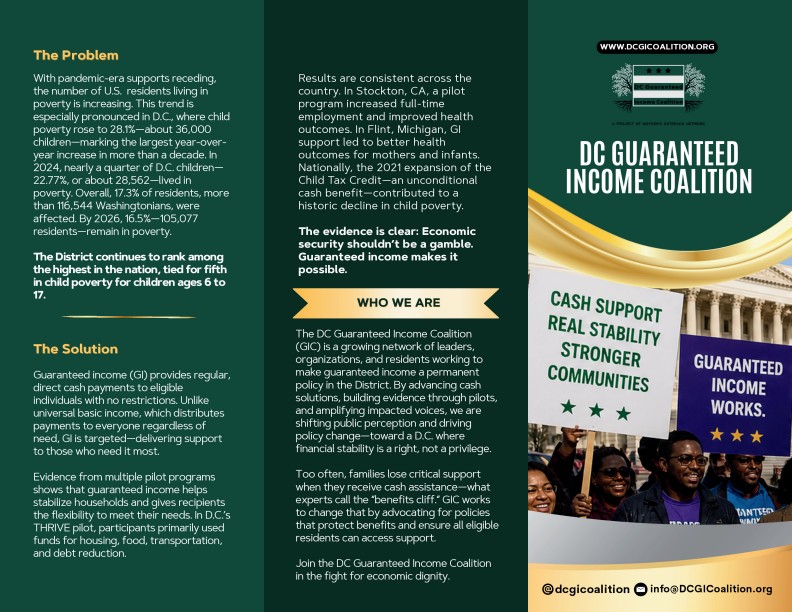
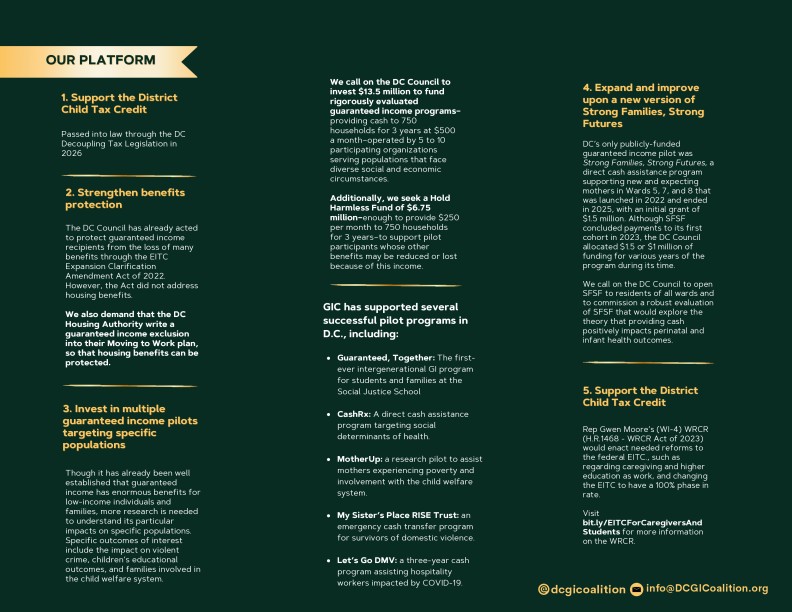
Everyone in the program will have the opportunity to receive incentive payments for participating in research activities of surveys and interviews. All participants will also be eligible to participate in Mother’s Outreach Network’s empowerment and leadership programs. Roughly half of the participants in the program will also receive $500 a month, no work and not other strings attached and will gain access to Mother’s Outreach Netowkr’s legal program. will have the opportunity to receive incentive payments for participating in research like surveys and interviews. Half of the people in the program will receive $500 a month, no work and no other strings attached. They will also have access to Mother’s OUtreach Networ’s legal program. The other participants will be provided with legal referrals to external legal services providers. A computer will randomly select which participants will be provided the $500 a month and access to MON’s legal program.
DC Guaranteed Income Coalition